/start/your-dealer
Each Dealers.sh NFT is both a piece of generative art and a save file. The image you see on a marketplace is rendered directly from contract bytecode, and the gameplay state attached to that token (your cash, your stash, your reputation, your heat) lives in the same set of contracts. There is no separate database keeping track of your progress.
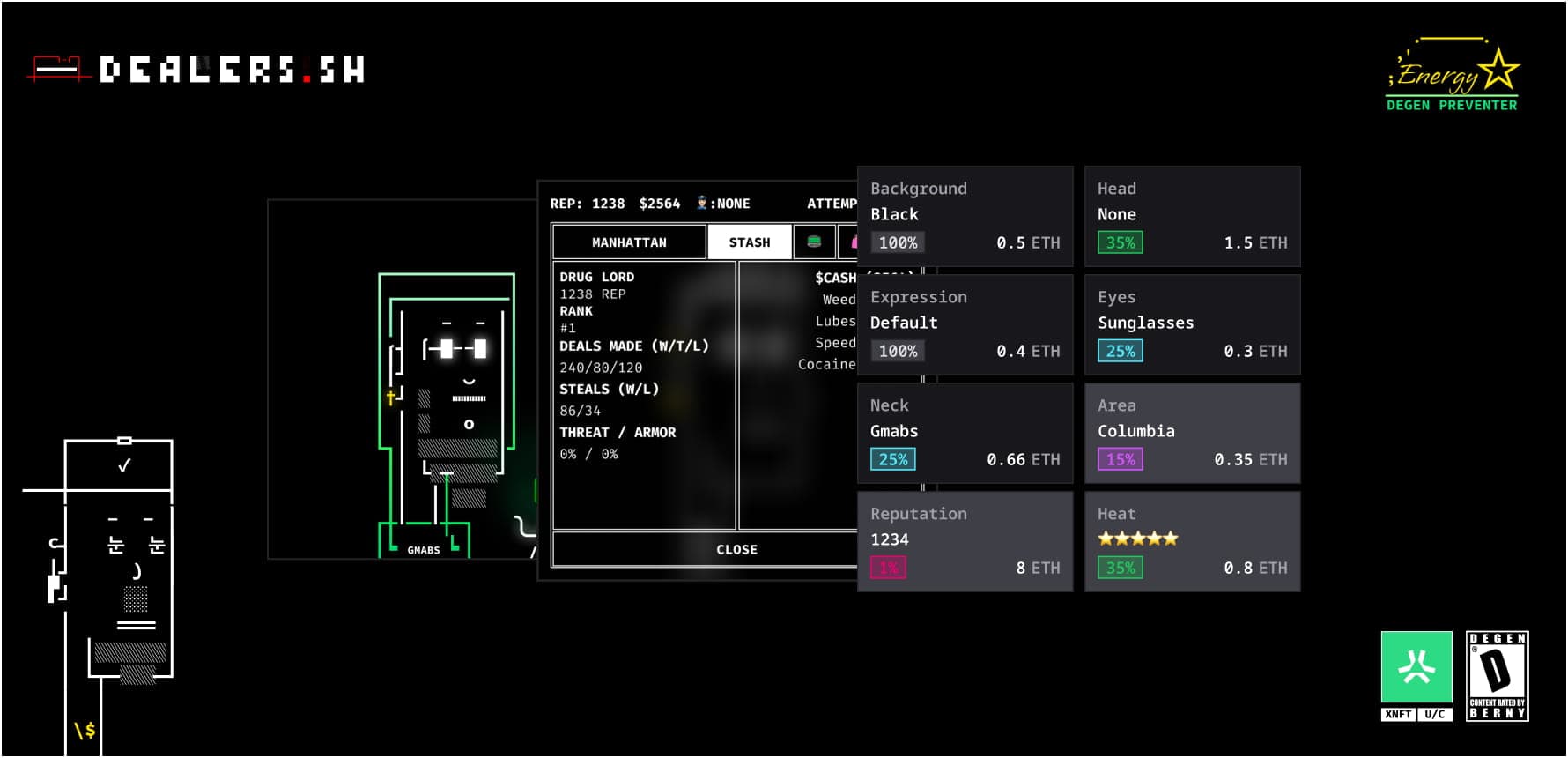
The art is on chain
When a wallet or a marketplace requests the metadata for your dealer, the contract assembles an SVG from packed trait data and returns it as part of the standard tokenURI response. Alongside that SVG, the animation_url contains the playable game HTML, gzipped and stored on chain through Abstract’s FileStore. Nothing about the visual or interactive experience depends on an external host.
For a deeper walkthrough of how the rendering pipeline works, see /the-art/rendering.
State that changes as you play
Each dealer has a handful of stats that move as you take actions. They are all stored on the contracts and visible to anyone who reads them.
| Stat | What it means |
|---|---|
| Reputation (REP) | Your standing in the family. Earned through deals and combat. Gates rank progression. |
| Heat | Police attention from 0 to 5. The higher it goes, the higher your risk of being sent to jail. |
| Cash | In-game working capital, used for buying drugs and other $CASH-denominated actions. Travel, bail, Clear Heat, and boosts use ETH instead. |
| Stash | Drugs you currently hold, tracked by type and quantity. |
| Attempts | The number of actions you have left in the current period. Refills over time. |
| Infamy | A separate score that rises and falls with PVP outcomes and shapes how other players see you. |
Because each of these stats lives on chain, your dealer effectively levels up as you play, while the underlying NFT remains exactly the token you minted.
Traits and rarity
Each dealer is randomized at mint across several visual trait categories: background, hair, eyes, mouth, outfit, and accessory. Rarer combinations are exactly that — rarer. They affect how your dealer looks, not what your dealer can do. A common dealer with high reputation outranks a one-of-one with no track record.
See /the-art/rarity for the trait distribution.